

Nida Al-Qur'an: Jurnal Pengkajian Islam
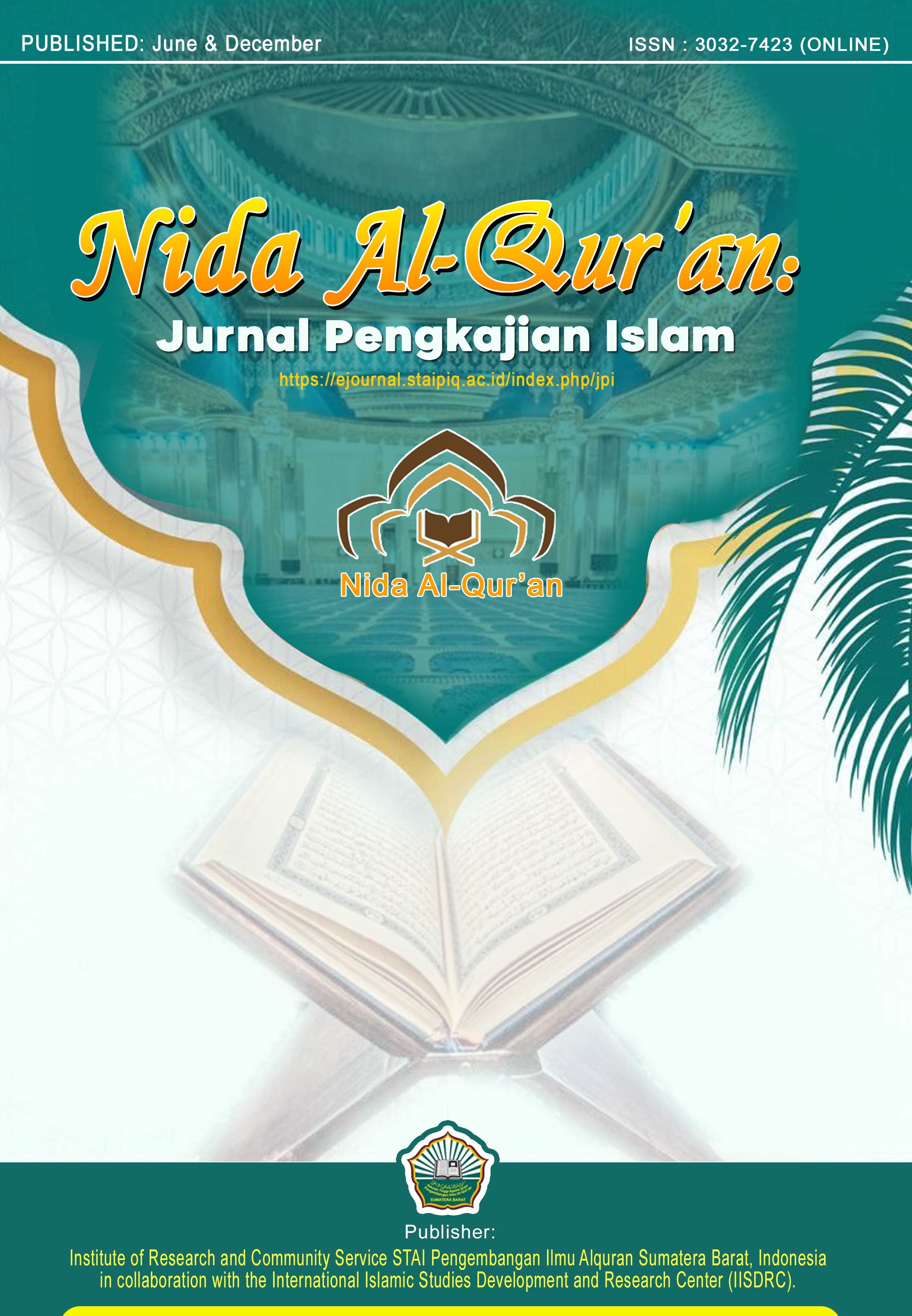
Nida Al-Qur'an: Jurnal Pengkajian Islam, Islamic sciences have a humanities and social sciences perspective. This journal also has a program that aims to bridge the gap between textual and contextual approaches in Islamic Studies, and resolving the dichotomy between orthodox and heterodox Islam. The two are... Read more
Editor's Pick
Hand-picked groundbreaking research and high-impact publications curated by our Editorial Board
Ahsan Al-Qasas in the Qur'an: A Comparative Analysis Of al-Thabari's and Ibn Katsir's Interpretations
The stories in the Qur'an serve as one of the primary means of conveying divine guidance, moral lessons, and values of life. Among these narratives, the story of Prophet Yusuf, described as Ahsan al-Qa?a? (the Best of Stories), holds a unique position and has attracted the attention of Qur'anic exegetes throughout history. This study aims to analyze the concept of Ahsan al-Qa?a? in the Qur'an according to Al-?abari and Ibn Katsir through a comparative exegetical approach. The study is motivated by the persistence of the misconception that the story of Prophet Yusuf is merely a historical narrative, overlooking its profound theological, educational, and divine principles that are highly relevant to human life. This research employs a library research method using a comparative tafsir approach. The primary sources include the Qur'an, J?mi? al-Bay?n ?an Ta?w?l ?y al-Qur??n by Al-?abari, and Tafs?r al-Qur??n al-?A??m by Ibn Katsir, while secondary sources consist of scholarly works relevant to the topic. The findings reveal that Ahsan al-Qa?a?, according to Al-?abari and Ibn Katsir, is characterized by the beauty of its narrative structure, the coherence of its storyline, the clarity of the divine laws reflected in it, and the profound lessons it offers concerning faith, morality, patience, and steadfastness. The study also identifies both similarities and methodological differences between the two exegetes, particularly in their interpretive approaches, use of transmitted reports (riw?y?t), and emphasis on spiritual and ethical values. Through a comparative tafsir approach, this research contributes to a deeper understanding of the Qur'anic narratives as an enduring source of guidance for all times and places.
??
??
The Concept of Qarin in the Qur'an and Its Relevance to Contemporary Friendship Qarin dalam Al-Qur???an dan Relevansinya dengan Pertemanan Zaman Sekarang
Penelitian ini bertujuan untuk menganalisis makna qar?n dalam al-Qur???an, mengidentifikasi macam-macam qar?n, serta menjelaskan relevansinya dengan pertemanan zaman sekarang. Penelitian ini menggunakan metode kualitatif dengan jenis penelitian kepustakaan (library research) dan pendekatan tafsir maudhu???i (tematik), yaitu dengan menghimpun ayat-ayat yang berkaitan dengan qar?n, kemudian menganalisisnya berdasarkan kitab-kitab tafsir dan literatur pendukung yang relevan. Hasil penelitian menunjukkan bahwa qar?n dalam al-Qur???an bermakna pendamping yang senantiasa menyertai manusia, baik dari kalangan setan, manusia, maupun malaikat, yang masing-masing memiliki pengaruh terhadap perilaku dan kehidupan seseorang. Dalam konteks pertemanan zaman sekarang, konsep qar?n memiliki relevansi yang kuat karena hubungan pertemanan dapat memberikan pengaruh positif maupun negatif terhadap moral, spiritual, dan kepribadian individu. Al-Qur???an memberikan pedoman agar manusia memilih teman yang baik, menjaga lingkungan pergaulan yang sehat, serta menjauhi pertemanan yang dapat menjerumuskan kepada kesesatan. Implikasi penelitian ini menunjukkan bahwa konsep qar?n dapat dijadikan landasan moral dan spiritual dalam membangun hubungan pertemanan yang harmonis dan sesuai dengan nilai-nilai Islam di era modern.
Implementation of Abraham Maslow's Humanistic Learning Theory in the Learning Process
This research aims to examine the implementation of Abraham Maslow's humanistic learning theory in the learning process. The method used in this research is the Systematic Literature Review (SLR) method. This research data uses the main source of information by analyzing documents related to Abraham Maslow's Humanistic learning theory in the learning process. The research results show that the implementation of Abraham Maslow's humanistic learning theory is very relevant to the learning process where there are five human needs that can be applied in the learning process, namely: first, physiological needs where parents must pay attention to children starting from nutrition and other needs because this will relate to development a child; second, the need for safety and security where educators such as parents and teachers must provide a sense of security and safety for children; third, the need to be loved and loved, where the need to love and have someone, parents must create good closeness to their children and a teacher must provide motivation; fourth, the need to be respected. In the learning process, every effort made by students should be respected and the attitude must be equal to all children and there should be no favoritism between students because each child has their own strengths; fifth, the need to increase self-actualization where in implementing humanistic learning theory students are given the opportunity to actualize themselves according to their talents and interests.
Social Dimension in the Hadiths of Ihsan
This study aims to examine the social dimension in the hadiths of the Prophet SAW containing the word ihsan contained in the kutul al-tis'ah (nine popular hadith books) with initial information from Mausu'ah Nadhratun Na'im. Through a qualitative approach, this study analyzes the texts of the hadiths of the Prophet SAW containing the word ihsan to identify the social dimension, it is expected that readers can deeply understand the relevance of ihsan in the modern social context and its important role in building an ethical and prosperous society. The results of the analysis show that through the hadiths of ihsan, the Prophet SAW emphasized the importance of doing good and giving the best in every aspect of life. Ihsan not only includes spiritual awareness that Allah always watches over every deed and focuses on the goodness of the individual, but also emphasizes good actions towards others, starting from the smallest community, namely family, relatives, neighbors, to the wider community. By practicing the values ??of ihsan, individuals can contribute to the creation of a harmonious and mutually supportive social environment.
??
Implementation Of the Iqra' Method in Learning to Read The Al-Qur'an In Early Age Children
The first lesson given to children in Islamic education is learning about the Koran. By introducing the Qur'an from an early age, Qur'anic values will be ingrained and make people with character. This research aims to determine the implementation of the Iqra' method in learning to read the Koran in early childhood. This research uses descriptive qualitative methods to obtain broad and in-depth information related to the research objectives. The data sources in this research were the principal, class teachers, students and parents of the students at Sabbihisma 2 Padang Kindergarten. The research results show that the Iqra' method learning planning is not explained in detail in the form of a lesson plan. The teacher teaches it according to the teaching instructions in the Iqra' book. The Iqra' method learning is carried out privately, students are called one by one to come forward to read Iqra'. Students are required to be active in reading, while the teacher guides and directs the learning process. Evaluation of Iqra' method learning is carried out during Iqra' learning by the teacher and EBTA at the end of each volume of Iqra' is carried out by the school principal. Supporting factors for learning Iqra' are providing motivation to students, the role of parents who support learning Iqra' or the Koran at home, conveying the Iqra' method to parents of students, and teacher training. Meanwhile, the inhibiting factors are students' low memory capacity, students who are unable to concentrate, and lack of repetition of Iqra' or Al-Qur'an reading at home.
Smokers' Behavior Following the Fatwa of the Indonesian Ulama Council
The Indonesian Ulama Council, as the highest authority issuing fatwas on Islamic law in Indonesia, has issued several fatwas concerning health and social behavior. One significant fatwa prohibits smoking in public places, reflecting concerns over its health impacts on both smokers and those exposed to passive smoking. This study aims to examine changes in smoking behavior following the issuance of the Indonesian Ulama Council fatwa, which prohibits smoking for pregnant women, children, and in public places. Employing a qualitative method with a case study approach, the research involves in-depth interviews and observations with six informants familiar with and affected by this phenomenon. All data are analyzed thematically using the Miles & Huberman interactive analysis model. The analysis reveals three categories of smokers post-fatwa: i) those who quit due to heightened awareness of smoking's dangers; ii) those who continue due to lack of awareness about the ban; and iii) those who persist due to perceived personal benefits from smoking, understanding the ban applies only to specific groups. This study underscores the need for enhanced education and socialization efforts regarding the fatwa and smoking cessation to promote broader compliance.
Development of Modern Science and Classical Islamic Philosophy
This article tells the story of the spirit of seeking and spreading knowledge in Islam which has been interestingly demonstrated by figures in the classical Islamic period. Carrying out translations, rewriting and copying of books from Persian to Arabic or Greek in the Islamic world. This article would like to inform you that current science and of course philosophy at large has the services of Muslim scientists and civilization in it, in terms of accelerating the transmission of classical thought into modern world thought. This research uses a qualitative method with a thematic analysis approach, this article succeeded in finding that Islam has a significant role in the 'formation' of modern science today.
Islamic Personal Development Activities in shaping the Character of Students in Junior High Schools
This research is to produce graduates who are willing and able to carry out the commands of Allah and His Messenger, stay away from all the prohibitions of Allah and His Messenger, love their nation, and have adequate life skills according to their time. This research is field research using descriptive methods. Results The research is as follows: i) forms of developing students' Islamic character, namely, coaching by example, instilling disciplinary values, coaching by habituation, environmental conditioning, and integration-internalization. ii) forms of Worship Habits, namely, Tahfizh Quran, Dhuha Prayer, Reading Prayers Together, Carrying out Zuhr and Asr Prayers in Congregation and getting used to the Morning and Evening Recitation of Al-Ma'tsurat. iii) the form of Mahabbatul Quran, namely, Recitations of the Quran, Understanding the Quran and Tadabbur Quran iv) the form of Community Service, namely by getting to know the community more closely, improving the quality of relationships with the community and practicing critical thinking. in interacting and communicating with others. v) supporting factors consist of parental support, teachers who have been trained, all teachers are coaches and school culture. Meanwhile, the inhibiting factors are the personality characteristics of students, limited time because there are 2 curricula implemented, namely the National Curriculum and the Curriculum.

Google Scholar Metrics
Citation data accurately synchronized with author profilesEducator from the Perspective Quran
Islam has a very high regard for teachers. The position of teachers is a level below that of Prophets and Apostles. Some of their hadith histories have received nicknames war??tsatu al-anbiy?? (heirs of the prophets), and likened their superiority compared to others, like the full moon in the midst of the stars. In fact, the high position of teachers in Islam is a realization of Islamic teachings themselves. Islam glorifies knowledge, knowledge is obtained from learning and teaching. Because Islam is a religion, the view of teachers, the position of teachers, cannot be separated from heavenly values. While the Quran mentions at least four classifications of educators, they basically have "similarities" in coaching students according to their respective objectives and lead to the enforcement of the sentence of Allah. This research uses a qualitative method with a thematic analysis approach. Based on an investigation of the verses of the Quran which contain vocabulary as an educator, it can be concluded that the vocabulary of ahl al-zikr, ???ulama, al-muwaiz al-waizin, uli al-nuha, mu???allim, al-muzakki, murabbi, al-rasikhuna fi al-???ilm, ulul albab and ulu al-absar actually have meanings that are interconnected or intertwined. As shown above, there are some vocabulary words that have almost the same meaning, but there are also vocabulary words with special emphasis. Broadly speaking, the verses that contain a variety of vocabulary confirm that an educator needs various qualities and with those qualities he works to carry out the mission of educating.
Implementation of Abraham Maslow's Humanistic Learning Theory in the Learning Process
This research aims to examine the implementation of Abraham Maslow's humanistic learning theory in the learning process. The method used in this research is the Systematic Literature Review (SLR) method. This research data uses the main source of information by analyzing documents related to Abraham Maslow's Humanistic learning theory in the learning process. The research results show that the implementation of Abraham Maslow's humanistic learning theory is very relevant to the learning process where there are five human needs that can be applied in the learning process, namely: first, physiological needs where parents must pay attention to children starting from nutrition and other needs because this will relate to development a child; second, the need for safety and security where educators such as parents and teachers must provide a sense of security and safety for children; third, the need to be loved and loved, where the need to love and have someone, parents must create good closeness to their children and a teacher must provide motivation; fourth, the need to be respected. In the learning process, every effort made by students should be respected and the attitude must be equal to all children and there should be no favoritism between students because each child has their own strengths; fifth, the need to increase self-actualization where in implementing humanistic learning theory students are given the opportunity to actualize themselves according to their talents and interests.
Six Values of Muhammad Nur Abdul Hafizh Suwaid's Moral Education for Early Childhood
The application of the basic principles of Islamic teachings from the aqidah aspect of educating early childhood in the household can be applied based on the pillars that have been put forward by Muhammad Nur Abdul Hafizh Suwaid, namely dictating Tawheed sentences to children, instilling children's love for Allah, always asking for help and supervision. only to Allah and believe in the provisions of Allah SWT, instilling children's love for the Prophet Muhammad SAW, teaching the Qur???an to children, and instilling strong beliefs and a willingness to make sacrifices for it. The application of the basic principles of Islamic teachings from the aspect of worship educates young children in the household through from an early age parents have to get used to and teach children to pray, take children to the mosque, fast, teach about what the Hajj is, and zakat. The application of the basic principles of Islamic teachings from the moral aspect of educating young children in the household is based on Muhammad Suwaid's opinion, namely teaching children from an early age about manners, honesty, keeping secrets, being trustworthy, open-minded, and not being envious.
Development of Modern Science and Classical Islamic Philosophy
This article tells the story of the spirit of seeking and spreading knowledge in Islam which has been interestingly demonstrated by figures in the classical Islamic period. Carrying out translations, rewriting and copying of books from Persian to Arabic or Greek in the Islamic world. This article would like to inform you that current science and of course philosophy at large has the services of Muslim scientists and civilization in it, in terms of accelerating the transmission of classical thought into modern world thought. This research uses a qualitative method with a thematic analysis approach, this article succeeded in finding that Islam has a significant role in the 'formation' of modern science today.
Social Dimension in the Hadiths of Ihsan
This study aims to examine the social dimension in the hadiths of the Prophet SAW containing the word ihsan contained in the kutul al-tis'ah (nine popular hadith books) with initial information from Mausu'ah Nadhratun Na'im. Through a qualitative approach, this study analyzes the texts of the hadiths of the Prophet SAW containing the word ihsan to identify the social dimension, it is expected that readers can deeply understand the relevance of ihsan in the modern social context and its important role in building an ethical and prosperous society. The results of the analysis show that through the hadiths of ihsan, the Prophet SAW emphasized the importance of doing good and giving the best in every aspect of life. Ihsan not only includes spiritual awareness that Allah always watches over every deed and focuses on the goodness of the individual, but also emphasizes good actions towards others, starting from the smallest community, namely family, relatives, neighbors, to the wider community. By practicing the values ??of ihsan, individuals can contribute to the creation of a harmonious and mutually supportive social environment.
??
CONTEMPORARY PROBLEMS CONCERNING GRAVES IN THE VIEW OF THE QUR'AN AND SUNNAH
Islam and its teachings are sourced from the Qur'an and Sunnah, all problems can be answered correctly according to the development of the times. One example of today's case is the issue of the demolition of graves because they did not pay levies to the local government. Also the problem of the Review of the Qur'an and Sunnah regarding graves because of the limited cemetery land in big cities, the graves of someone who has died, both pious and unpious people, the prophets, aulia, Kiyai such as raising graves, making grave markers with wooden tombstones or permanent tombstones made of stone, so that legal certainty is needed to answer these problems based on the guidance of the Qur'an and Sunnah. The method used is library research by collecting all information relevant to this discussion, so that a conclusion can be drawn on the problems faced by Muslims. The results of the review of the Qur'an and Sunnah in this article can be concluded as follows: 1. Review of the Qur'an and Sunnah: making grave markers with wooden headstones or permanent headstones from stones, laying just stones or tombstones (permissible) because they have a basis in Islam. This is due to efforts to mark the grave so that it is easy to recognize and easy to visit in the future. 2. Review of the Qur'an and Sunnah: installing a tombstone on top of the grave or providing a roof or house over it, namely: The grave may be raised just one inch so that it is recognized as a grave and is easier to visit, and also so that it is more respected by pilgrims. It is forbidden to put cement on graves and write on them and it is also forbidden to build buildings on graves.
??
Explore All Published Issues
Browse our comprehensive repository of past volumes, special editions, and conference proceedings dating back to our inaugural release.
View All IssuesNida Al-Qur'an: Jurnal Pengkajian Islam
Nida Al-Qur'an: Jurnal Pengkajian Islam, Islamic sciences have a humanities and social sciences perspective. This journal also has a program that aims to bridge the gap between textual and contextual approaches in Islamic Studies, and resolving the dichotomy between orthodox and heterodox Islam. The two are interrelated: textual traditions show that Islam, as well as a range of religious teachings, is a way of dealing with practical challenges in economic and social life. So, this journal invites the intersection of several scientific disciplines and scholars. In other words, the contributors borrow from a variety of disciplines, including the humanities and social sciences. Nida Al-Qur'an: Jurnal Pengkajian Islam Islamic Sciences is published by the Research and Community Services Center of STAI-PIQ West Sumatera - Indonesia. Nida Al-Qur'an: Jurnal Pengkajian Islam is published twice in June and December every year.
Journal Specifications
- e-ISSN: 3032-7423
- p-ISSN: 3032-7423
- Avg. Review Time: 91 Days
- Acceptance Rate: 22% (Rigorous Review)
- Frequency: Annual (1 Issue/Year)
International Editorial Board
Our editorial team comprises esteemed professors, active researchers, and industry leaders from prestigious universities worldwide dedicated to academic excellence.
Editorial & Reviewer Team
Rigorous double-blind peer review structure
Indexed & Abstracted Databases
Our journal articles are actively indexed, assigned permanent DOIs, and preserved across globally authoritative scientific repositories.




Indexed & Abstracted In
Recognized by leading global scientific indexing and bibliographic databases
For Authors & Researchers
Essential tools, guidelines, and workflows for your academic journey
|
|
Nida Al-Qur'an: Jurnal Pengkajian Islam, Islamic sciences have a humanities and social sciences perspective. This journal also has a program that aims to bridge the gap between textual and contextual approaches in Islamic Studies, and resolving the dichotomy between ???orthodox??? and ???heterodox??? Islam. The two are interrelated: textual traditions show that Islam, as well as a range of religious teachings, is a way of dealing with practical challenges in economic and social life. So, this journal invites the intersection of several scientific disciplines and scholars. In other words, the contributors borrow from a variety of disciplines, including the humanities and social sciences. Nida Al-Qur'an: Jurnal Pengkajian Islam Islamic Sciences is published by the Institute for Research and Community Service STAI Pengembangan Ilmu Al-Qur'an Sumatera Barat, Indonesia in collaboration with the International Islamic Studies Development and Research Center (IISDRC). Nida Al-Qur'an: Jurnal Pengkajian Islam is published twice in June and December every year. OAI Address Before submission, You have to make sure that your paper is prepared using the Nida Al-Qur'an Template,??has been carefully proofread and polished, and conformed to the??author guidelines.
??
Online Submissions
Registration and login are required to submit items online and to check the status of current submissions.??
|
