
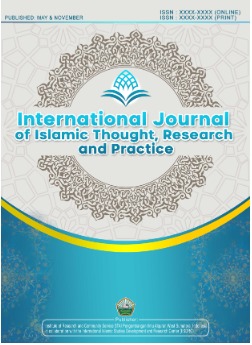
This issue has been available online since 30 th April 2026 for the Issue Qur'an, Hadith and Tafseer. All articles in this issue (5 original research articles) were authored/co-authored by 27 authors from 13 college and 7 countries (Indonesia, Thailand, Egypt, Sudan, Inggris, Malaysia and Pakistan).


Articles
The Influence of Parents' Occupations on Islamic Religious Education Learning Outcomes of Students at State Vocational High School 1 Lubuk Basung
The purpose of this study was to determine the description of parents' occupations, description of Islamic Religious Education (PAI) learning outcomes, and to determine the influence of parents' occupations on students' PAI learning outcomes at State Vocational High School 1 Lubuk Basung. This study was motivated by the assumption that parents' occupations are one of the external factors that can influence the success of children's learning achievements at school. The method used in this study is quantitative descriptive analysis and verification, with the type of Expost Facto research. The population of this study was all 65 students of class XI majoring in TKJ at State Vocational High School 1 Lubuk Basung. The sampling technique used Total Random Sampling, where 50 students were used as the main sample. Data collection was carried out through questionnaires for the variables of Parents' Occupations (X) and student report card scores for PAI Learning Outcomes (Y), supported by observation and documentation. Data analysis used descriptive statistics and simple linear regression analysis tests, after testing the assumptions of normality and homogeneity. The results of descriptive research indicate that the occupation of parents of students at SMK Negeri 1 Lubuk Basung is classified as very good, with a mean value of 58.92 (68% of respondents are in this classification). Meanwhile, the description of students' Islamic Religious Education learning outcomes is classified as less high, with a mean value of 83.16 (42% of respondents are in the interval 78-83). Based on the hypothesis test using simple linear regression analysis, a significance value (sig) of 0.836 was obtained, which is greater than the significance level of 0.05. Thus, Ho is accepted and Ha is rejected, which means there is no significant influence between parental occupations on Islamic Religious Education Learning Outcomes of students at SMK Negeri 1 Lubuk Basung. The contribution of parental occupations to Islamic Religious Education learning outcomes is only 0.1% (R square 0.001), while the remaining 99.9% is influenced by other factors. The implications of this study conclude that student learning outcomes are not determined by parents' occupation or income, but rather by other factors such as intelligence, interests, learning motivation, time management skills, and the environment. Therefore, parents are advised to pay more attention to their students' learning process at home, provide motivation, and create a comfortable and conducive learning environment. Schools are also advised to increase collaboration with parents and develop programs that can help improve students' Islamic Religious Education learning outcomes.
The Integrating Science and the Values of Tawhid in the Thot of Ismail Raj'i Al-Faruqi: Its Relevance to Modern Islamic Education
Ismail Raji Al-Faruqi's idea of integrating knowledge with the values of monotheism is a relevant conceptual offering for the reform of Islamic education in the contemporary era. This research aims to examine Al-Faruqi's thoughts on the integration of science and tawhid and its implications for the development of the curriculum and modern Islamic education system. This research uses a qualitative approach with a literature study method. Data sources were obtained from Al-Faruqi's major works, such as Islamization of Knowledge and Tauhid: Its Implications for Thot and Life, and were supported by various relevant literature including books, scientific journals, and previous research. Data analysis was conducted using content analysis and descriptive-interpretative techniques. The research results indicate that tawhid serves as an epistemological foundation that unites revelation, reason, and reality, while simultaneously rejecting the separation between religious and general sciences. This integration demands a holistic, transdisciplinary, and character-building curriculum update for Islamic education, focusing on the moral and spiritual development of students. Thus, this research confirms that Al-Faruqi's thinking has strong relevance as a basis for developing Islamic education that is balanced between intellectual dimensions and Islamic values in facing the challenges of modern education.
The Strategies of Aqidah-Akhlak Teachers in Fostering the Character Development of Fifth-Grade Students at MIN 05 Padang City
This study focuses on effective, sustainable character-building strategies that are aligned with students??? developmental characteristics. The objectives of this research are to describe: (1) the strategies employed by Aqidah-Akhlak teachers in fostering the character of fifth-grade students, (2) the students??? character traits manifested during the learning process and school interactions, and (3) the supporting factors, inhibiting factors, and solutions implemented by teachers in character development at MIN 05 Padang City. This study employed a qualitative research method with a descriptive approach. Data were collected through in-depth interviews, observations, and documentation, while data analysis consisted of data reduction, data display, and conclusion drawing. The findings indicate that Aqidah-Akhlak teachers apply several key strategies, including moral habituation through role modeling, character development through religious activities, persuasive approaches, behavioral supervision, as well as motivation and positive reinforcement. Students??? character development is reflected in discipline, responsibility, politeness, cooperation, care, and spirituality, although some aspects still require improvement. Supporting factors for character development include a religious school environment, support from homeroom teachers, and well-structured madrasah programs. Inhibiting factors stem from limited parental attention, peer influence, and time constraints in learning activities. Aqidah-Akhlak teachers address these challenges through intensive communication with parents, collaboration with other teachers, repeated moral guidance, and strengthening habituation in daily madrasah activities.
Establishing An Islamic State According To Islamic Law From The Perspective Of The Qur'an
This study examines the concept, legal basis, and normative framework for establishing an Islamic state from the perspective of Islamic law, drawing upon the Qur???an, Hadith, fiqh siyasah, and the views of classical and contemporary Muslim scholars. The research is motivated by the ongoing debate concerning the relationship between Islam and the state, particularly the renewed calls by certain Muslim groups for the establishment of an Islamic state or caliphate within the context of the modern nation-state. This research employs a normative-qualitative method through library research, utilizing a thematic interpretation of Qur???anic verses, analysis of prophetic traditions, and a comparative study of the political thought of scholars such as al-Mawardi, al-Ghazali, Ibn Taymiyyah, al-Maududi, and an-Nabhani. The findings indicate that neither the Qur???an nor the Hadith prescribes a fixed or rigid model of statehood. Instead, they emphasize fundamental principles of governance, including justice (al-???adl), consultation (al-sh?r?), trust (am?nah), equality, the rule of law, and the realization of public welfare (ma?la?ah). From the perspective of Islamic law, the establishment of a state is regarded as a collective obligation (far? kif?yah) aimed at ensuring the implementation of amr ma???r?f nahy munkar and the preservation of religious and social order. An Islamic state is thus understood as a political institution whose primary function is to uphold the objectives of Islamic law (maq??id al-shar????ah), rather than merely serving as a formal symbol of religious authority.
The Effect of Implementing the Project Based Learning Model on the Collaborative Skills of Students at Al Padang Private Islamic Senior High School
This research is motivated by the importance of collaboration skills in today's globally integrated world and the findings that the collaboration skills of students at the Al Falah Private Islamic Senior High School (MAS) in Padang are still suboptimal, with many students tending to work alone and passively in group discussions. One proposed solution is the implementation of the Project-Based Learning (PjBL) model, which emphasizes student involvement in challenging, real-world projects to enhance collaboration skills. This study aims to (1) describe students' collaboration skills, (2) describe the implementation of Project-Based Learning, and (3) determine the effect of the Project-Based Learning model on students' collaboration skills at the Al Falah Private Islamic Senior High School in Padang.This study used quantitative methods with statistical analysis techniques. The study population was 64 students with a sample size of 48. Data collection was conducted through questionnaires and observations. Data analysis techniques included normality tests, homogeneity tests, and hypothesis testing using simple linear regression analysis. The results of the study show that (1) the average Project Based Learning learning at MAS Al Falah Padang is in the fairly good category (mean interval 25.51 ??? 30), and (2) the average collaboration skills of students are also in the fairly good category (mean interval 36.5 ??? 42.9). (3) There is a significant influence of the application of the learning model. Project-Based Learning's impact on students' collaboration skills is demonstrated by a significance value of 0.00 (<0.05) in the ANOVA test. The effect of Project-Based Learning on collaboration skills was 30.7% (r-square value of 0.307), while the remaining 69.3% was influenced by other factors. The implications of this study recommend that teachers continue to develop the implementation of Project-Based Learning with a more structured approach, increase interaction and collaboration among students, and conduct regular evaluations of the effectiveness of this learning model. Furthermore, it is important to identify and support other factors that contribute to collaboration skills, such as the learning environment, student motivation, and supporting facilities