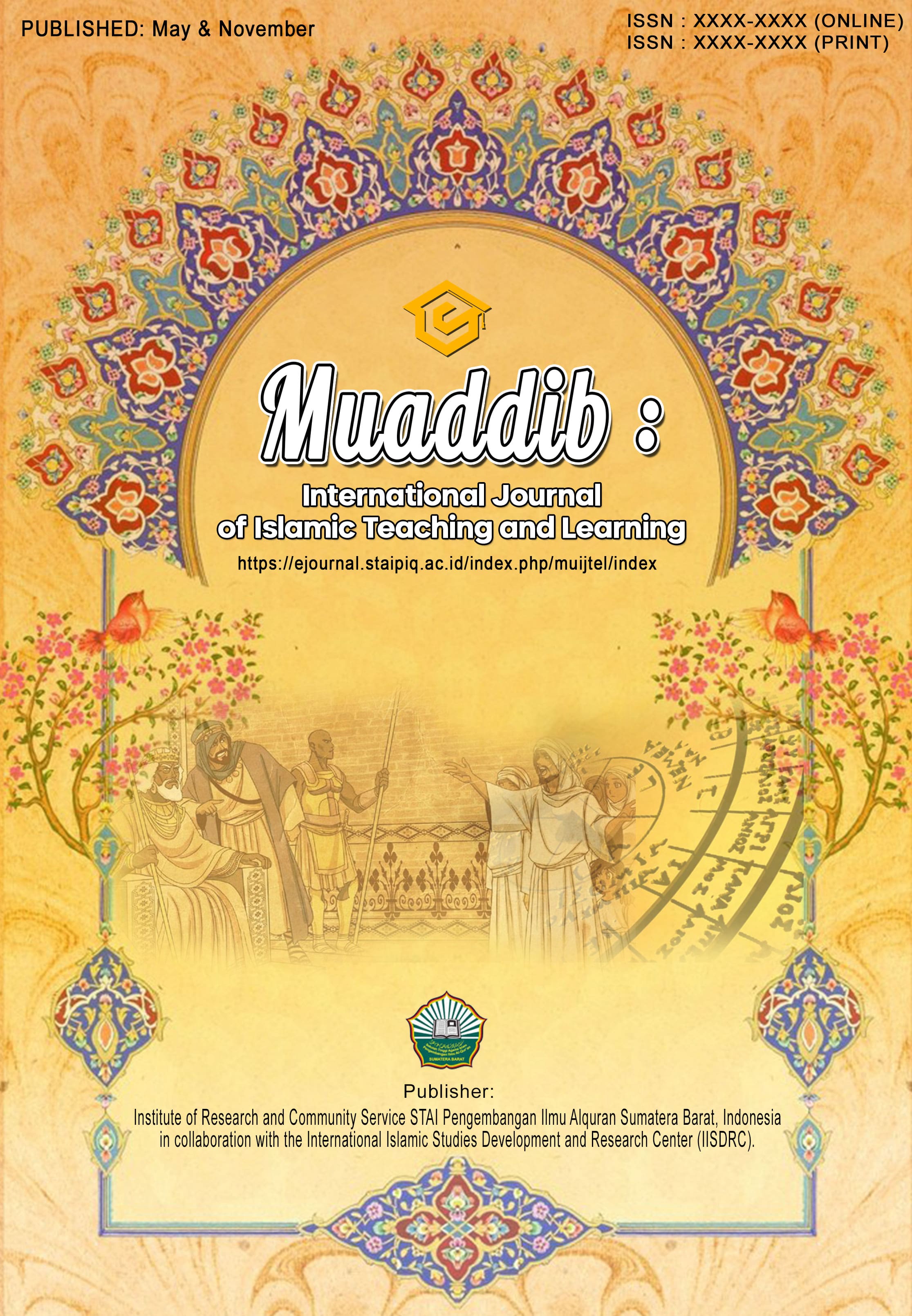
Muaddib: International Journal of Islamic Teaching and Learning
Muaddib: International Journal of Islamic Teaching and Learning is an international peer-reviewed journal published by STAI-PIQ Press. The Journal published in April and October every year, open to authors worldwide regardless of nationality. International Journal... Read more
Editor's Pick
Hand-picked groundbreaking research and high-impact publications curated by our Editorial Board
Integration of Simple Media and Technology in Akidah Akhlak Learning: Strategies, Challenges, and Utilization
The development of information and communication technology has influenced teaching practices in various educational contexts, including Islamic education. In Aqidah Akhlak learning, the use of instructional media is essential because the subject matter emphasizes abstract concepts and moral values that must be internalized by learners. This paper aims to describe the role and importance of simple media and simple technology in supporting Aqidah Akhlak learning. The study employs a qualitative descriptive approach through a review of relevant literature related to instructional media, educational technology, and Islamic education. The discussion shows that simple media, such as visual aids, audio materials, real objects, and basic learning tools, can effectively support students understanding and engagement in learning activities. In addition, simple technology is considered more appropriate for value-based learning because it encourages focus, interaction, and reflection without excessive dependence on complex digital devices. The use of simple media and technology also reflects Islamic educational practices that emphasize simplicity, relevance, and meaningful learning. Therefore, the integration of simple media and technology can be an effective alternative for improving the quality of Aqidah Akhlak learning, particularly in educational environments with limited facilities
Reconstruction of the Problematics of Islamic Education at Dr. M. Natsir Islamic Boarding School from the Perspective of Islamic Educational Philosophy Reconstruction of the Problematics of Islamic Education at Dr. M. Natsir Islamic Boarding School from the Perspective of Islamic Educational Philosophy
This study aims to examine and reconstruct the problems of Islamic education at Dr. M. Natsir Islamic Boarding School from the perspective of contemporary Islamic educational philosophy. This research employs a qualitative approach using a case study design, conducted through in-depth interviews, participant observation, and documentation studies involving pesantren leaders, teachers, curriculum managers, and students. Data were analyzed thematically using the framework of Islamic educational philosophy encompassing ontological, epistemological, and axiological dimensions.
??The findings indicate that the main problem of Islamic education in this pesantren does not lie in the backwardness of its educational system, but rather in excessive modernization that weakens the classical scholarly traditions of the pesantren. Such modernization has led to a shift in educational goals, the weakening of traditional modes of knowledge transmission, reduced intensity of tur?? (classical Islamic texts) studies, and the erosion of scholarly ethics (adab) among students.
Based on these findings, the study recommends reconstructing pesantren Islamic education by reaffirming the goal of tafaqquh f? al-d?n (deep understanding of religion) and the formation of ethically grounded individuals, revitalizing traditional pesantren learning methods, and integrating modernity proportionally as a supportive instrument in education. The implications of this research are expected to serve as a conceptual foundation for developing an integrative pesantren education model rooted in Islamic intellectual tradition while remaining relevant to contemporary educational challenges.
An Analysis of Supporting and Inhibiting Factors in Strengthening Religious and Moral Values in Orphanages
This study aims to describe the patterns of character building among children at the Putra 'Aisyiyah Orphanage in Padang City and analyze the factors that support and hinder it, while also examining its contribution to strengthening religious and moral values. This study is field research with a descriptive qualitative approach. The data were collected through documentation, interviews, and observation, then analyzed using reduction, presentation, and conclusion drawing techniques. Data were collected through documentation, interviews, and observation, then analyzed using reduction, presentation, and conclusion drawing techniques. The results show that character building activities are carried out systematically through habitual worship, recitation, memorization of the Qur'an, tausiyah (religious lectures), and role modeling by caregivers. The main factors supporting the success of character building include a conducive religious environment, role modeling by mentors, and integration between religious and social education. Meanwhile, the inhibiting factors were the limited number of mentors, the influence of the outside environment, and the negative impact of digital media on the behavior of the children. Overall, character building at the Putra 'Aisyiyah Orphanage contributed significantly to strengthening the religious and moral values of the children. Values such as honesty, responsibility, empathy, discipline, and compassion can be developed through consistent and exemplary guidance patterns.
Faith and Morals from the Perspective of Al-Ghazali and Ibn Miskawaih: Comparative Analysis and Its Relevance for Contemporary Islamic Education
The issue of faith and morality remains a fundamental challenge in contemporary Islamic education, particularly in developing a holistic and sustainable religious character. Amidst the trend toward cognitive and normative education, this study revisits the thoughts of classical scholars, particularly al-Ghazali and Ibn Miskawaih, as a relevant conceptual foundation to address this need. This study aims to understand and compare the thoughts of al-Ghazali and Ibn Miskawaih on faith and morality, while also examining their relevance to the development of contemporary faith and morality education models. The specific objectives of the study include: (1) explaining al-Ghazali's thoughts on faith and morality; (2) analyzing Ibn Miskawaih's thoughts on faith and morality; (3) conducting a comparative analysis of the concepts of faith and morality of both figures; and (4) examining the contributions of their thoughts to contemporary Islamic education. This study uses a literary or library approach, collecting data from printed books, scientific journals, and online sources, thus providing comprehensive insight into the study's theme. The results of the study show that al-Ghazali and Ibn Miskawaih have different approaches in developing morals; al-Ghazali emphasizes the spiritual dimension and purification of the soul through the internalization of faith, while Ibn Miskawaih emphasizes rationality, moral habituation, and systematic self-control. Despite their differences, both agree that the balanced development of the mind, heart, and spirit is the foundation for moral formation. These findings indicate that the thoughts of al-Ghazali and Ibn Miskawaih remain relevant as a foundation for holistic, value-based faith and moral education, and are capable of forming a comprehensive religious character in the context of contemporary Islamic education.
Ibn Taymiyyah's Philosophical Thoughts on Education in the Perspective of Modern Western Educational Thought
This study aims to analyze Ibn Taimiyah's philosophical thot on education from the perspective of modern Western educational thought, and to find common ground and potential for its integration with contemporary educational challenges. This study uses a qualitative approach with a philosophical-comparative method based on literature review. The research findings indicate that Ibn Taymiyyah's thot emphasizes the importance of integrating knowledge derived from revelation (sam'iyyat) and rational knowledge ('aqliyyat), thus forming the concept of beneficial knowledge (al-'ilm al-nafi') which combines spiritual and intellectual dimensions. Conversely, modern Western education places more emphasis on rationality, freedom of thought, and the development of human potential thru empirical experience, as taught by John Dewey and William C. Bagley. The fundamental difference between the two lies in the source of the value of revealed truth in Islam and reason in the West, but they can complement each other. The conceptual synthesis between these two perspectives results in an integrative education model that combines the strengths of Islamic spirituality and Western rationality to shape individuals who are knowledgeable, ethical, and civilized. This research has implications for the need to develop an Islamic education curriculum that is transcendental, contextual, and able to meet global demands without losing the value of monotheism.
Analysis of the Relationship between Self-Regulated Learning and Students' Quran Memorizing Activities in Junior High Schools
Self-regulated learning is a person's ability to control oneself, such as knowing one's abilities, motivation, managing memory and responding appropriately to the environment. Alquran memorization activity self-regulated learning. A person who memorizes the Quran will always go through these four items, therefore study is needed so that memorizers of the Quran understand them well. This research aims to analyze the relationship between self-regulated learning with the activity of memorizing the Koran for students in junior high school. This research design uses quantitative methods with a correlational approach. The data source was taken using a questionnaire or questionnaire. The research sample consisted of forty students in junior high schools. This research was analyzed using SPSS 26.0 with correlation analysis techniques. The research results show that self-regulated learning has a real impact on memorizing the Quran. The research results show that there is an influence of self-regulated learning towards the activity of memorizing the Quran. It is known that the value of the determinant coefficient with R is a large square amounting to 0.503 x 100, namely 50.3%. This concludes that there is an influence between variable (X) and variable (Y) of 50.3%, therefore the remaining 49.7% is influenced by other factors. The implications of this research can be used as initial data for future researchers in studying this problem in different contexts and issues.
Six Roles of Teacher Organizations in Improving Professional Competence
Islamic Religious Education Subject Teacher Deliberation is a forum for developing teacher competency as well as correcting problems that exist in the teaching and learning process. This research aims to analyze the role of Islamic Religious Education Subject Teacher Deliberations in improving teachers' professional competence. This research uses qualitative methods with a case study approach (case study design). Data sources were taken from ten informants through in-depth interviews who were selected using the technique of purposive sampling, all informants are active educators and work as Islamic Religious Education teachers in the Islamic Religious Education Subject Teacher Conference activities throughout the city of Padang. All data obtained was analyzed through Milles Huberman's thematic analysis. The results of the analysis show that the role of the Islamic Religious Education Teacher organization in improving the professional competence of Islamic Religious Education teachers is: i) increasing the effectiveness of learning, ii) developing Islamic Religious Education materials (book reviews, seminars), iii) solving students' problems in learning, iv) workshop developing an independent curriculum, v) compiling materials teaching, vi) training in learning models. The results of this research can be used as initial data for future researchers in studying this problem in different contexts and issues.
Guidance for Dormitories in Strengthening the Religious Character of Students
This research aims to determine the form of girls' dormitory programs at Madrasah Aliyah in strengthening the religious character of students. The author uses a qualitative method with a descriptive approach in this research. The data collection techniques used were interviews, observation, and documentation. Data analysis techniques are through data collection, data reduction, data presentation, and conclusion. The results of the analysis found ten dormitory programs in strengthening students' religious character, namely i) congregational prayer program, ii) tahfidzul Alquran, iii) tadarus Alquran, iv) monthly wirid, v) An-Nisaa forum, vi) a commemoration of Islam held every Islamic holiday, vii) safari Ramadan, viii) morning assembly, ix) language day, and x) sports. The results of this research can be used as initial data for future researchers in studying this problem in different contexts and issues.
Educating Memorizers of the Quran: What Should Teachers do?
Choosing to become a teacher is each person's choice, you need to know that becoming a teacher is not easy, and there are many challenges. Apart from that, teachers must be able to be a motivator for their students, to achieve success in learning well. This research aims to determine the efforts of tahfizh teachers in improving the memorization of the Quran in tahfizh households in Indonesia. This research uses a qualitative method with a case study type. Data sources were taken from thirty-three informants consisting of three teachers and thirty students through direct interviews using a set of interview protocols. The informants involved were selected using a purposive sampling technique, from three years of entry, namely 2020, 2021, and 2022. All interview data was analyzed thematically using the Milles & Hubberman Interactive Analysis Model technique. The research findings found three efforts by Tahfizh Teachers to Improve Al-Quran Memorization at Indonesian Tahfizh Houses. The three efforts of the tahfizh teacher are i) Giving praise for each student's achievements, ii) providing assessments and prizes, and iii) Ego-Involvement. This research has revealed the efforts used by tahfizh teachers in developing students to memorize the Quran. In addition, the results of this research can be used as a reference for anyone who wants to become a memorizer of the Quran.
Analysis of Surau Educational Activities in Educating the Islamic Generation
This research discusses education carried out outside formal schools, namely education carried out in Surau or Mushalla, the implementation focuses on Islamic religious education and Quran education in depth. This research aims to analyze how the Quran education program is based on moral values ??in surau. This research uses a qualitative method with an ethnographic approach, data sources were taken through in-depth interviews with five informants consisting of administrators, teachers, parents and students. The research results were; i) reading the Quran, ii) learning the science of recitation, iii) studying fiqh, iv) Islamic art and v) learning morals. This research can be used as a reference source for further research on the same issues and topics.
SIM Influence of Interaction Social Towards the Morals of Students
The background of this research is the importance of understanding how interactions social interaction among students can affect their morals. In the context of education, positive social interactions among students can also improve students' morals. This study aims to determine the influence of social interaction (x) on students' morals (y). The purpose of this study was to determine: (1) How is the description of social interaction at SMP Negeri 6 Padang, (2) How is the description of students' morals at SMP Negeri 6 Padang, (3) Is there an influence of social interaction on students' morals at SMP Negeri 6 Padang. This study is included in the type of quantitative research using a correlational design. The data collection technique used in this study was a questionnaire. The population used in this study was all class VIII students with a sample size of 28 students. The data analysis technique used was the normality test, homogeneity test, hypothesis test using simple linear regression techniques. The results of this study are: (1) Social interaction in SMP Negeri 6 Padang is classified as good, namely when viewed from the mean or average value of 48.00 which occupies the interval 45-50 with a standard deviation of 23, if presented the result is 56%. (2) The morals of students in SMP Negeri 6 Padang are classified as good, namely when viewed from the mean or average value of 44.56 which occupies the interval 45-50 with a standard deviation of 21, if presented the result is 44% (3) There is an influence between social interaction (x) on the morals of students (y) based on the simple linear regression formula, the data obtained sig results are 0.00 4 <0.05 (significant level 5%). So Ha is accepted and Ho is rejected, then based on data analysis it is known that R Square 0.165 x 100% = 16.5%. hereby stated that there is an influence between social interaction on students' morals of 16.5%.

Google Scholar Metrics
Citation data accurately synchronized with author profilesSix Roles of Teacher Organizations in Improving Professional Competence
Islamic Religious Education Subject Teacher Deliberation is a forum for developing teacher competency as well as correcting problems that exist in the teaching and learning process. This research aims to analyze the role of Islamic Religious Education Subject Teacher Deliberations in improving teachers' professional competence. This research uses qualitative methods with a case study approach (case study design). Data sources were taken from ten informants through in-depth interviews who were selected using the technique of purposive sampling, all informants are active educators and work as Islamic Religious Education teachers in the Islamic Religious Education Subject Teacher Conference activities throughout the city of Padang. All data obtained was analyzed through Milles Huberman's thematic analysis. The results of the analysis show that the role of the Islamic Religious Education Teacher organization in improving the professional competence of Islamic Religious Education teachers is: i) increasing the effectiveness of learning, ii) developing Islamic Religious Education materials (book reviews, seminars), iii) solving students' problems in learning, iv) workshop developing an independent curriculum, v) compiling materials teaching, vi) training in learning models. The results of this research can be used as initial data for future researchers in studying this problem in different contexts and issues.
Analysis of the Relationship between Self-Regulated Learning and Students' Quran Memorizing Activities in Junior High Schools
Self-regulated learning is a person's ability to control oneself, such as knowing one's abilities, motivation, managing memory and responding appropriately to the environment. Alquran memorization activity self-regulated learning. A person who memorizes the Quran will always go through these four items, therefore study is needed so that memorizers of the Quran understand them well. This research aims to analyze the relationship between self-regulated learning with the activity of memorizing the Koran for students in junior high school. This research design uses quantitative methods with a correlational approach. The data source was taken using a questionnaire or questionnaire. The research sample consisted of forty students in junior high schools. This research was analyzed using SPSS 26.0 with correlation analysis techniques. The research results show that self-regulated learning has a real impact on memorizing the Quran. The research results show that there is an influence of self-regulated learning towards the activity of memorizing the Quran. It is known that the value of the determinant coefficient with R is a large square amounting to 0.503 x 100, namely 50.3%. This concludes that there is an influence between variable (X) and variable (Y) of 50.3%, therefore the remaining 49.7% is influenced by other factors. The implications of this research can be used as initial data for future researchers in studying this problem in different contexts and issues.
Guidance for Dormitories in Strengthening the Religious Character of Students
This research aims to determine the form of girls' dormitory programs at Madrasah Aliyah in strengthening the religious character of students. The author uses a qualitative method with a descriptive approach in this research. The data collection techniques used were interviews, observation, and documentation. Data analysis techniques are through data collection, data reduction, data presentation, and conclusion. The results of the analysis found ten dormitory programs in strengthening students' religious character, namely i) congregational prayer program, ii) tahfidzul Alquran, iii) tadarus Alquran, iv) monthly wirid, v) An-Nisaa forum, vi) a commemoration of Islam held every Islamic holiday, vii) safari Ramadan, viii) morning assembly, ix) language day, and x) sports. The results of this research can be used as initial data for future researchers in studying this problem in different contexts and issues.
Educating Memorizers of the Quran: What Should Teachers do?
Choosing to become a teacher is each person's choice, you need to know that becoming a teacher is not easy, and there are many challenges. Apart from that, teachers must be able to be a motivator for their students, to achieve success in learning well. This research aims to determine the efforts of tahfizh teachers in improving the memorization of the Quran in tahfizh households in Indonesia. This research uses a qualitative method with a case study type. Data sources were taken from thirty-three informants consisting of three teachers and thirty students through direct interviews using a set of interview protocols. The informants involved were selected using a purposive sampling technique, from three years of entry, namely 2020, 2021, and 2022. All interview data was analyzed thematically using the Milles & Hubberman Interactive Analysis Model technique. The research findings found three efforts by Tahfizh Teachers to Improve Al-Quran Memorization at Indonesian Tahfizh Houses. The three efforts of the tahfizh teacher are i) Giving praise for each student's achievements, ii) providing assessments and prizes, and iii) Ego-Involvement. This research has revealed the efforts used by tahfizh teachers in developing students to memorize the Quran. In addition, the results of this research can be used as a reference for anyone who wants to become a memorizer of the Quran.
SS Analysis of Authenticity of The Qur???an on Al-Qur???an Hadith Learning at Madrasah Aliyah
The authenticity of the Qur'an as a miracle serves to challenge anyone who doubts it. In addition to functioning as a miracle, the Qur'an contains wisdom that concerns all aspects of life. The wisdom contained in the Qur'an is one of them in the form of science, so in this study the author wants to analyse the authenticity of the Qur'an in learning Al-Quran Hadith in madrasah aliyah. The research method used is a qualitative method with a content analysis approach, the main source is the Qur???an Hadith textbook published by the Ministry of Religion of the Republic of Indonesia. After conducting an in-depth analysis, the author can find the structure of the Quran Hadith material in Madrasah Aliyah related to the authenticity of the Quran consists of three sub-themes. The three sub-themes are: i) Allah's Guarantee of the Purity of the Quran, ii) Collection of the Quran, iii) Bookkeeping of the Quran during the Time of Uthman bin Affan. In the future, the author hopes that this research will have a positive impact, especially in madrasah as a formal educational institution with the characteristic of instilling Islamic values to its students.
Qur???anic and Prophetic Terminologies of Learners: A Study of Islamic Educational Concepts
The study aims to analyze and synthesize the Islamic understanding of students as reflected in the terms mutarabbi, muta???allim, muta???addib, thalib, and daris/mutadarris, which describe the comprehensive dimensions of human education. This study explores the concept of students in the perspective of the Qur???an and Hadith through the Systematic Literature Review (SLR) method using a qualitative-descriptive approach. Data were obtained from primary sources, the Qur???an and Hadith as well as secondary references, including classical tafsir works and Islamic educational literature. The findings reveal that the concept of students in Islam extends beyond the conventional notion of learners as passive recipients of knowledge. Instead, students are viewed as active, dynamic individuals engaged in a continuous educational process involving tarbiyah (holistic education and guidance), ta???lim (learning and instruction), and ta???dib (discipline and moral cultivation). Each term emphasizes a unique aspect of development: mutarabbi refers to nurturing; muta???allim to the pursuit of knowledge; muta???addib to ethical and spiritual refinement; thalib to the active seeker of truth; and daris/mutadarris to continuous reflection and study. Collectively, these concepts indicate that Islamic education aims to form individuals who are intellectually competent, morally upright, spiritually aware, and socially responsible embodying the ideal balance between knowledge, faith, and ethical action.
Explore All Published Issues
Browse our comprehensive repository of past volumes, special editions, and conference proceedings dating back to our inaugural release.
View All IssuesMuaddib: International Journal of Islamic Teaching and Learning
Muaddib: International Journal of Islamic Teaching and Learning is an international peer-reviewed journal published by STAI-PIQ Press. The Journal published in April and October every year, open to authors worldwide regardless of nationality. International Journal of Islamic Teaching and Learning is an discusses and raises various issues related to Islamic education both theoretically and practically, while also raises the issue of research in Islamic education such as: technology, curriculum, media and learning model, instruments for evaluation in Islamic education, learning development for Islamic education, and action researches. Articles will be published if they were scientifically valuables, providing new knowledge and useful for the community of Islamic education. We were inviting scientists, researchers and professionals in the subject of Islamic education to submit their papers in our journal.
Journal Specifications
- e-ISSN: 3026-4758
- p-ISSN: 3026-4758
- Avg. Review Time: 117 Days
- Acceptance Rate: 13% (Rigorous Review)
- Frequency: Biannual (2 Issues/Year)
International Editorial Board
Our editorial team comprises esteemed professors, active researchers, and industry leaders from prestigious universities worldwide dedicated to academic excellence.
Editorial & Reviewer Team
Rigorous double-blind peer review structure
Indexed & Abstracted Databases
Our journal articles are actively indexed, assigned permanent DOIs, and preserved across globally authoritative scientific repositories.




Indexed & Abstracted In
Recognized by leading global scientific indexing and bibliographic databases
For Authors & Researchers
Essential tools, guidelines, and workflows for your academic journey
| Journal Title | Muaddib: International Journal of Islamic Teaching and Learning |
| Initials | Muaddib |
| Abbreviation | muaddib |
| Frequency | 2 issues per year (April and October) |
| DOI | Prefix 10.63061 by Crossref |
| Online ISSN | On Process |
| Editor-in-Chief | Hasnah STAI Pengembangan Ilmu Al-Qur'an Sumatera Barat, Indonesia |
| Managing Editor | Rahmat STAI Pengembangan Ilmu Al-Qur'an Sumatera Barat, Indonesia |
| Publisher | STAI-PIQ Press |
| Citation | Google Scholar |
About the Journal
Muaddib: International Journal of Islamic Teaching and Learning is an international peer-reviewed journal published by STAI-PIQ Press. The journal is published in April and October every year, and is open to authors worldwide regardless of nationality.
The journal discusses and raises various issues related to Islamic education both theoretically and practically, including research in Islamic education such as technology, curriculum, media and learning models, evaluation instruments, learning development, and action research. Articles are published if they are scientifically valuable, providing new knowledge and utility for the Islamic education community. We invite scientists, researchers, and professionals in the field of Islamic education to submit their papers.
OAI Address: Muaddib OAI Endpoint
Submission Guidelines
Before submitting your paper, please make sure that:
- Your paper is prepared using the official Muaddib Article Template.
- It has been carefully proofread, polished, and conforms to the Author Guidelines.
Registration and login are required to submit items online and to check the status of current submissions.